Cafe Curtains: How to Measure and Calculate Fabric
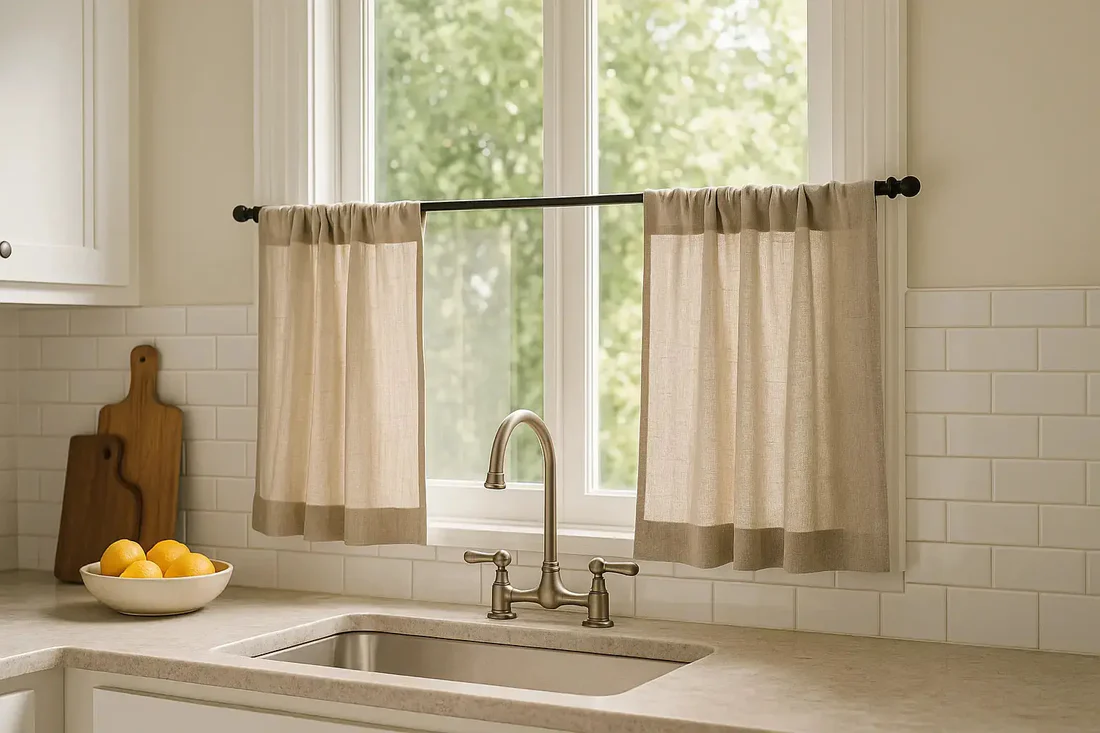
Cafe curtains cover only the lower portion of a window, letting natural light in through the top while maintaining privacy at eye level. They are most common in kitchens, bathrooms, and street-facing rooms where full-length coverage isn't needed — but the privacy-to-light trade-off matters a lot.
Because cafe curtains break from the standard floor-to-ceiling or sill-length conventions, their measurements work differently. Rod placement drives everything, and getting it right before cutting any fabric is the single most important step in the process.
What Makes a Curtain "Cafe Style"
A cafe curtain is defined by where it sits on the window, not by its header or fabric type. The rod is mounted partway down the window frame, typically at the midpoint or lower third, so the panel covers only the bottom half or bottom third of the glass. The top of the window is left open to daylight.
The style originated in European cafes and bistros where patrons needed privacy from the street without losing the ambient light that made the space feel welcoming. Today the look is popular in residential kitchens, breakfast nooks, bathroom windows over a tub, and any window that faces a sidewalk or neighboring property.
Most cafe curtains use a rod pocket header because it suits the informal, relaxed aesthetic. Tab top and clip-ring versions exist, but rod pocket is by far the most fabricated style in workrooms.
Where to Mount the Rod
Rod placement for cafe curtains is a design decision, not a fixed rule. The three most common positions are:
| Placement | Rod Position | Best For |
|---|---|---|
| Midpoint | Center of the window height | Even privacy and light balance; the classic cafe look |
| Lower third | About one-third up from the sill | Maximum light, privacy only at knee/counter level |
| Upper third | About one-third down from the top | Maximum privacy with a sliver of light at the top |
For kitchen windows, the lower-third placement is popular because it keeps the countertop area private from street view while flooding the room with light. For bathroom windows, the midpoint or upper-third placement is more common because full privacy is a priority.
Once the rod position is decided, install the bracket (or mark where it will go) before taking any measurements. All length measurements derive from the mounted rod position, so measuring before the hardware is placed leads to errors.
How to Measure for Cafe Curtains
Cafe curtain measurements follow the same logic as any rod pocket panel, but the reference points are different. You are measuring from the rod down to the sill (or wherever the panel will end), not from a standard floor or ceiling height.
Finished Length
Measure from the bottom of the rod (where the fabric will hang) down to your desired finish point. The most common finish points are:
- Windowsill: Panel ends just at or slightly below the sill. Clean and tailored. Add ½" below the sill for a tidy break.
- Below sill: Panel extends 2"–4" past the sill for a relaxed, slightly longer look that is forgiving on uneven sills.
- Apron: Panel ends at the bottom of the window apron (the trim below the sill). Adds visual weight to the window.
Most cafe curtains land at the sill or just below it. Measure the distance from the rod to your chosen finish point — that is your finished length.
Finished Width
Finished width for cafe curtains is measured bracket-to-bracket along the rod. If the rod extends beyond the window frame, measure the full span the fabric will cover. Include any return — the distance the rod projects out from the wall — in your finished width calculation, just as you would for a full-length panel.
Because cafe curtains often cover a single window without a center overlap, many workrooms fabricate them as a single panel gathered across the full rod rather than a pair. Confirm with the designer whether the treatment is a single panel or two panels before calculating widths.
Fullness for Cafe Curtains
Fullness for cafe curtains follows the same principles as any gathered rod pocket panel. The appropriate fullness depends on the fabric weight and the desired look:
- 1.5× – 2×: Light gather. Works well for sheers, lightweight cotton, and linen where a casual, airy look is the goal.
- 2× – 2.5×: Standard fullness. The most common choice for kitchen and bathroom cafe curtains in medium-weight cotton or cotton-blend fabrics.
- 2.5× – 3×: Full gather. Used for heavier fabrics or when a richer, more traditional look is desired.
Because cafe curtains are short panels, they tend to look best with slightly more fullness than a comparable floor-length panel. A shorter panel with minimal fullness can look sparse or flat. Erring toward 2× or higher is a reliable rule of thumb for most cafe curtain projects.
Calculating Cut Width
Cut width for a cafe curtain panel is calculated the same way as any rod pocket panel:
Total Fabric Width = (Finished Width + Returns) × Fullness + Side Hem Allowances
Divide that total by the fabric width (minus any selvedge allowance, typically ½" per side) to get the number of widths required. Round up to the nearest whole width or half-width depending on your workroom's standard practices.
For a single-panel cafe curtain, this number applies to the one panel. For a two-panel treatment, calculate each panel separately — each covers half the finished width plus its own return.
Footer Options
One of the defining features of a traditional cafe curtain is the option to run a second rod through a pocket at the bottom of the panel. This keeps the panel taut against the window, prevents billowing from drafts or open windows, and gives the treatment a clean, structured silhouette. There are three bottom finish options to choose from:
| Bottom Finish | Description | Best For |
|---|---|---|
| Footer Pocket & Ruffle | A rod slides through a sewn pocket at the bottom; a ruffle of fabric hangs below the rod | Decorative, cottage-style treatments; windows with prominent sills to dress |
| Footer Pocket Only | A rod slides through the bottom pocket with no ruffle; panel ends flush at the pocket edge | Clean, tailored look; windows where a ruffle would rest on the sill or feel too fussy |
| Hemmed Bottom | Standard double-folded hem; no bottom rod | Informal or lightweight treatments; when a second rod is not practical or desired |
When a footer rod is used, the finished length is measured from the top rod to the bottom rod — not to the sill. The footer ruffle (if included) then extends below the bottom rod, so it must hang freely and not be pressed against the sill or window frame. Account for this when determining the rod positions before measuring.
The footer pocket is sized the same way as the header pocket: add ¼" to ½" to the rod's outer diameter for a smooth fit. If both rods are the same diameter, both pockets will typically be the same size, which simplifies the calculation.
Calculating Cut Length
The header and footer are independent choices, and each one contributes differently to the cut length. The universal formula is:
Cut Length = Finished Length + Header Allowance + Footer Allowance + Cut Allowance
What goes into each allowance depends on the style selected.
Header Allowance
| Header Style | Allowance |
|---|---|
| Pocket + Ruffle | Ruffle Height + Pocket Size + Turn-Up |
| Pocket Only | Pocket Size + Turn-Up |
Footer Allowance
| Footer Style | Allowance |
|---|---|
| Pocket + Ruffle | Footer Ruffle + Footer Pocket Size + Footer Turn-Up |
| Pocket Only | Footer Pocket Size + Footer Turn-Up |
| Hemmed Bottom | Bottom Hem Allowance (typically 6"–8" for a double hem) |
Any header style can be combined with any footer style. A pocket-only header paired with a footer pocket and ruffle is just as valid as a pocket-and-ruffle header with a plain hemmed bottom — add the appropriate allowance from each table and the formula works the same way.
When using a hemmed bottom, a double 3" hem (6" of fabric) suits lighter fabrics; a double 4" hem (8") adds weight and helps short panels hang straight. Avoid going deeper than 4" on a very short panel as an oversized hem can look bottom-heavy.
Example: Pocket + Ruffle Header, Footer Pocket + Ruffle
- Finished length: 24" (top rod to bottom rod)
- Header ruffle: 1½"
- Header pocket: 1¼"
- Header turn-up: ½"
- Footer ruffle: 1"
- Footer pocket: 1¼"
- Footer turn-up: ½"
- Cut allowance: ½"
Cut Length = 24 + (1.5 + 1.25 + 0.5) + (1 + 1.25 + 0.5) + 0.5 = 30.5"
Example: Pocket Only Header, Hemmed Bottom
- Finished length: 24"
- Header pocket: 1¼"
- Header turn-up: ½"
- Bottom hem: 6" (double 3")
- Cut allowance: ½"
Cut Length = 24 + (1.25 + 0.5) + 6 + 0.5 = 32.25"
Fabric Yardage
Once you have the cut length and the number of widths, yardage is straightforward:
Total Yardage = (Cut Length × Number of Widths) ÷ 36
Add a cutting allowance of 4"–6" per panel set for workroom handling. If the fabric has a vertical repeat, the repeat rounding applied to the cut length already accounts for pattern matching waste — no additional allowance is needed for that.
Cafe curtains consume relatively little yardage compared to full-length panels, but the same percentage of ordering error hurts proportionally more because there is little slack to absorb the mistake. Accurate measurement before cutting is essential.
Lining Cafe Curtains
Cafe curtains are most often unlined, particularly in kitchens where moisture resistance and easy laundering are priorities. However, lining is sometimes added for:
- Light control: A blackout or dim-out lining on a bedroom or bathroom cafe curtain improves privacy when the light is on inside at night.
- Body and drape: A standard drapery lining gives even lightweight fabric more structure and helps a short panel hang without rolling at the hem.
- UV protection: South- or west-facing windows benefit from a lining that reduces fading on both the fabric and adjacent furniture.
When lining a cafe curtain, calculate lining yardage separately. The lining cut length is typically 1" shorter than the face fabric cut length so it remains hidden from the front when both hems are finished.
Rod and Hardware Considerations
Cafe curtain rods are typically narrower in diameter than full-length drapery rods — ⅝" to 1" is standard. Tension rods are widely used for cafe curtains because they require no drilling and suit the lightweight nature of the treatment. For heavier or lined cafe curtains, a standard bracket-mounted rod provides more reliable support.
The rod length should match the finished width of the treatment. For inside-mount cafe curtains (where the rod sits inside the window recess with no returns), measure the inside recess width and subtract ¼" so the rod fits without binding. For outside-mount rods that extend beyond the frame, add the desired extension on each side before purchasing.
Using the EZ Pleating Calculator for Cafe Curtains
The EZ Pleating Rod Pocket Calculator handles cafe curtain calculations exactly the same way it handles any rod pocket panel. Enter your finished length (measured from rod to sill), your rod width and returns, pocket size, ruffle height, fullness, and hem values — and the calculator outputs cut length, number of widths, and total yardage automatically.
Because cafe curtains are short, the arithmetic looks simple — but the repeat rounding, return additions, and hem proportions still add up quickly when you are handling multiple windows or a full kitchen treatment. The calculator eliminates the risk of transposing numbers on a short panel where every inch matters.
Summary
Cafe curtains are measured from the rod position down to the sill or apron, not from a standard floor or header height. Rod placement is a design choice that should be resolved before any measuring happens. The bottom finish — footer pocket with ruffle, footer pocket only, or standard hem — changes both the cut length formula and whether a second rod is needed, so that decision should be confirmed before calculating. Fullness of 2× to 2.5× is the reliable standard for most cafe curtain fabrics. Get both rods in place (or the single rod, for a hemmed treatment), measure carefully between them, and the rest of the calculation falls into place.
